An iPhone app that catches ideas the moment they strike
and brings old sparks back.
Overview
An app where thoughts come back on their own
Oryne is an iPhone app for people whose best ideas get lost in a notes list. Say or type a thought and let it go. The phone names it, drifts it next to related thoughts, and brings it back on a day it might matter.
Version 1 reached the App Store in July 2026. Three months of carrying it changed what the phone was for, and in October it was rebuilt around one gesture and three tabs, with an Apple Watch app beside it. This page is about that decision.
One thought comes back a day. Rest it, and the next rises
Live on the App StoreFirst commit to 1.0 in 23 daysSix releases in 15 daysRebuilt around one gesture in 2.0Intelligence runs on the deviceEnglish and Simplified Chinese
The Problem
Every notes app buries what it promised to keep
A thought gets lost in two places. First in the seconds it takes to unlock, find the app, and open a note. Then, if it made it in, in the list it lands in, where every new note pushes it further down. Lists optimize for putting things in. Minds optimize for things coming back.
01Lost in the moment
By the time a note opens, the thought is gone
02Lost in the list
Kept, then buried as every new note lands on top
Pinterest, Milanote, mymind, Freeform, Notion: each catches a thought fast, gives it a place to look around in, or brings it back unasked. None does all three for a thought of your own.
The Idea
Your mind as an ocean, and every decision derived from it
Water does all three without a filing system: things drift, related ones gather, and what sank comes up again on its own. So the mind became an ocean, and a thought became something you let go of rather than something you put away.
The metaphor was held to one rule: every interaction has to be explainable as how water works, never as how apps work. Two days into the build I wrote it down as eight principles, each ending in a test a review can cite, and put the file in the repository next to the code.
Three Tries Before It Looked Like Water
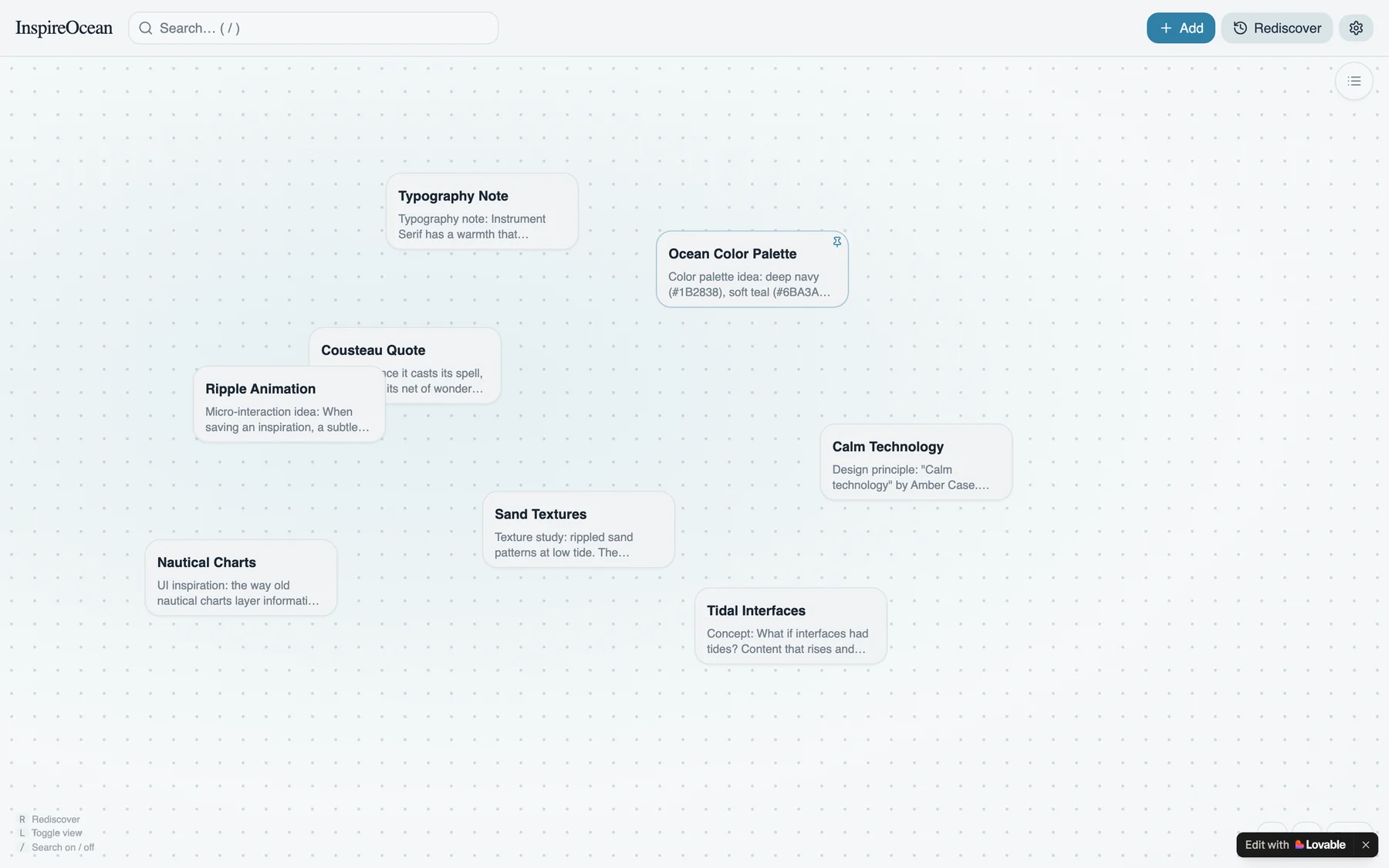
Web prototype: cards wherever you dropped them, a whiteboard rather than water
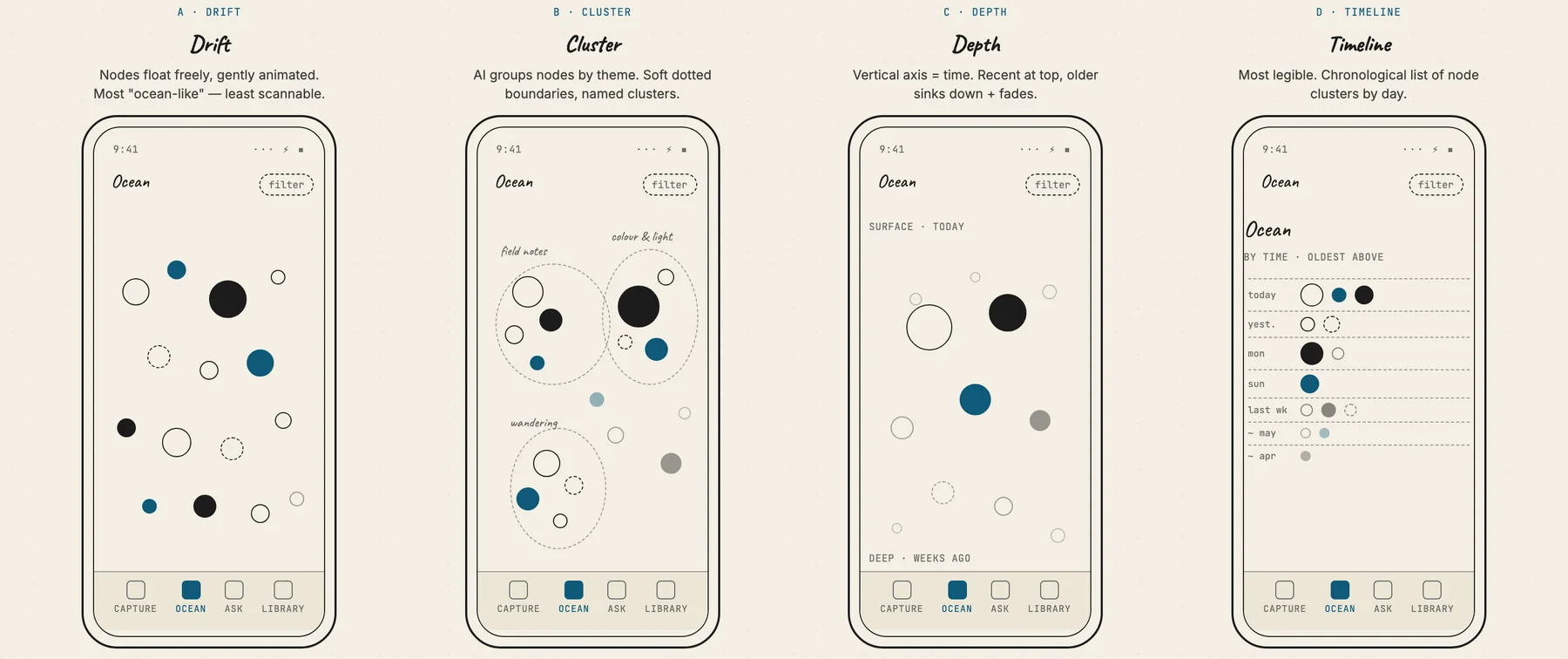
Wireframes: four layouts for the Ocean, from most like water to most legible
The first build: hold an orb, and the current it belongs to opens
Thought
“Carried into the sea”
One captured fragment, named and themed on the device.
Whisper
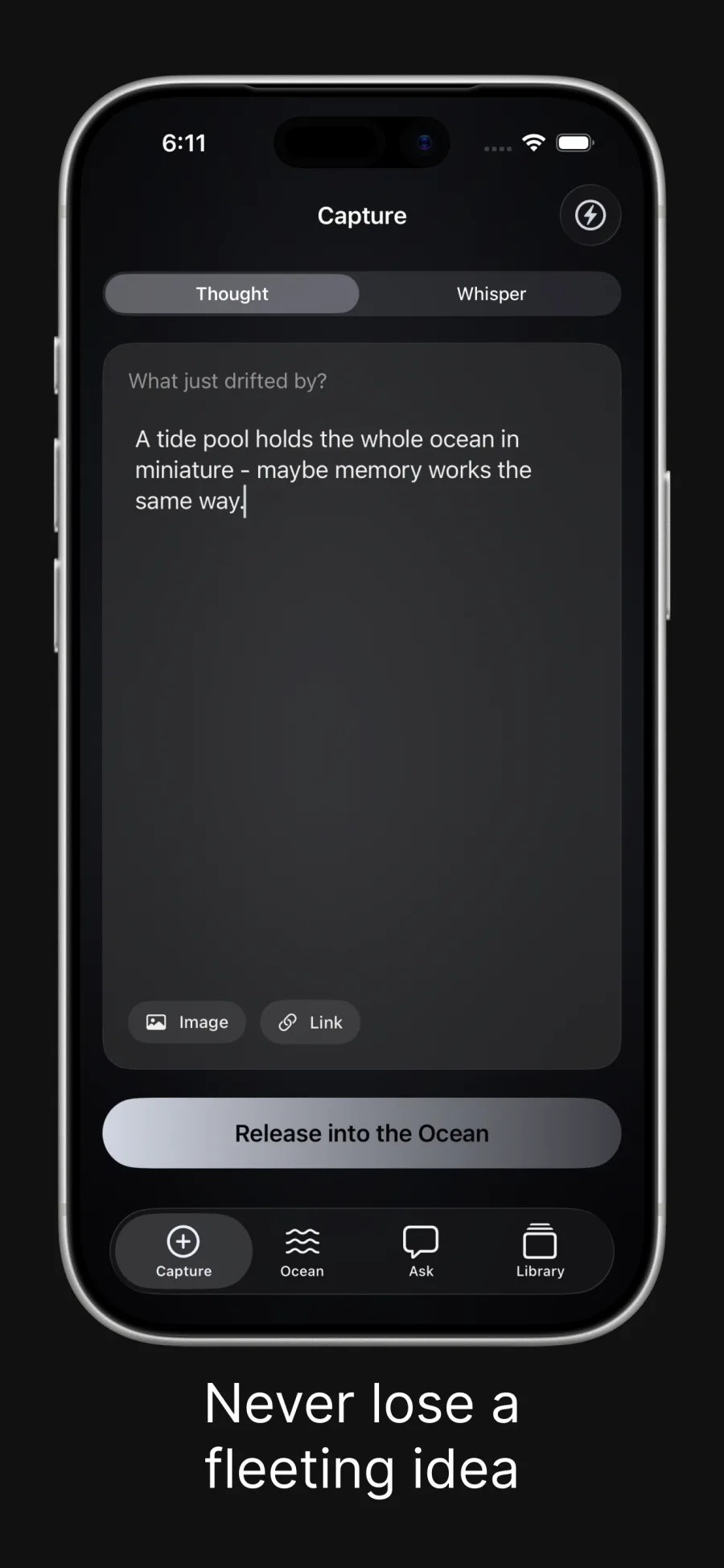
“Tap to type. Hold to whisper. Slide up to keep listening.”
A thought caught by voice, in one gesture.
Current
“Flows into “Light And Color””
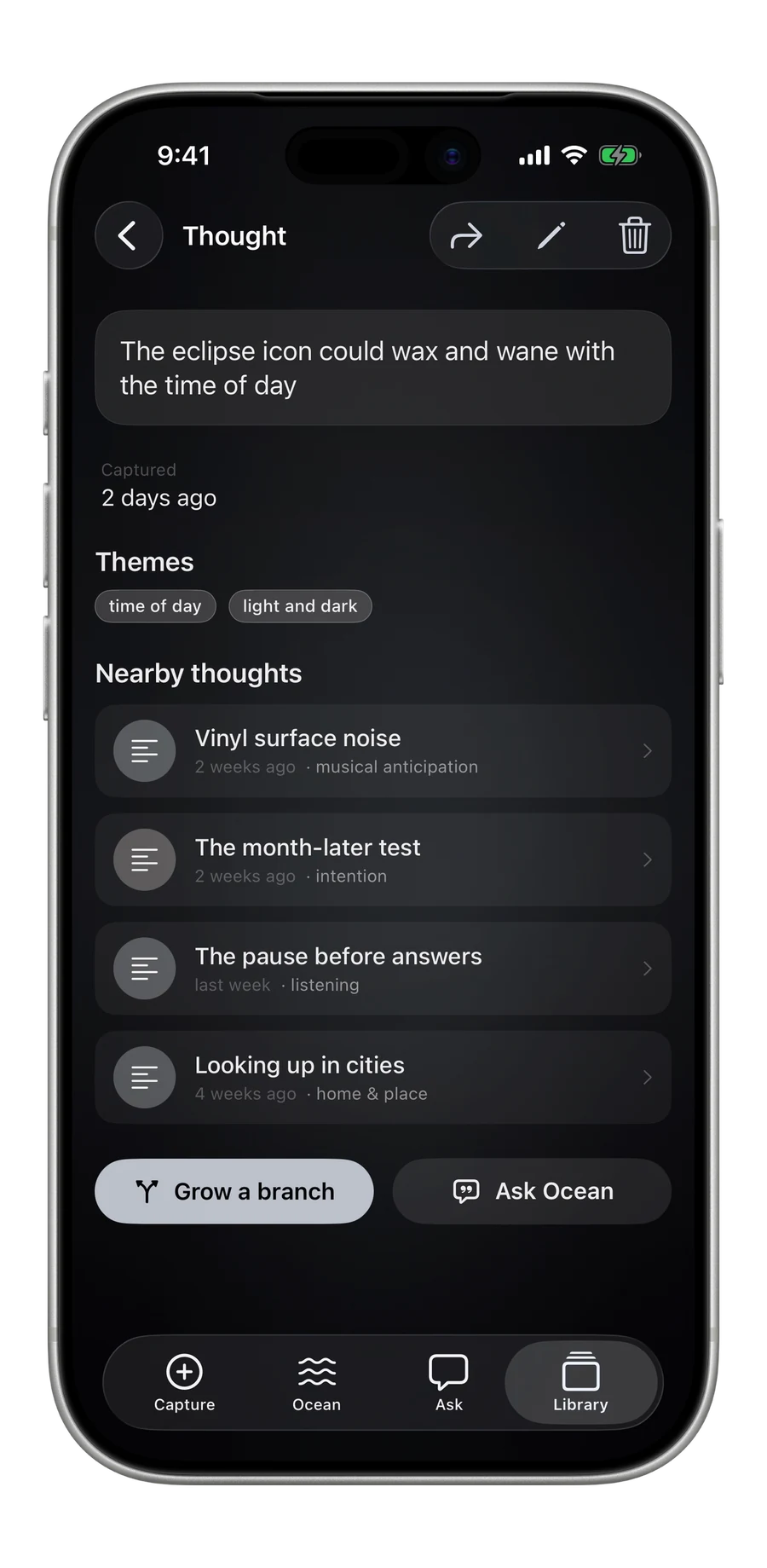
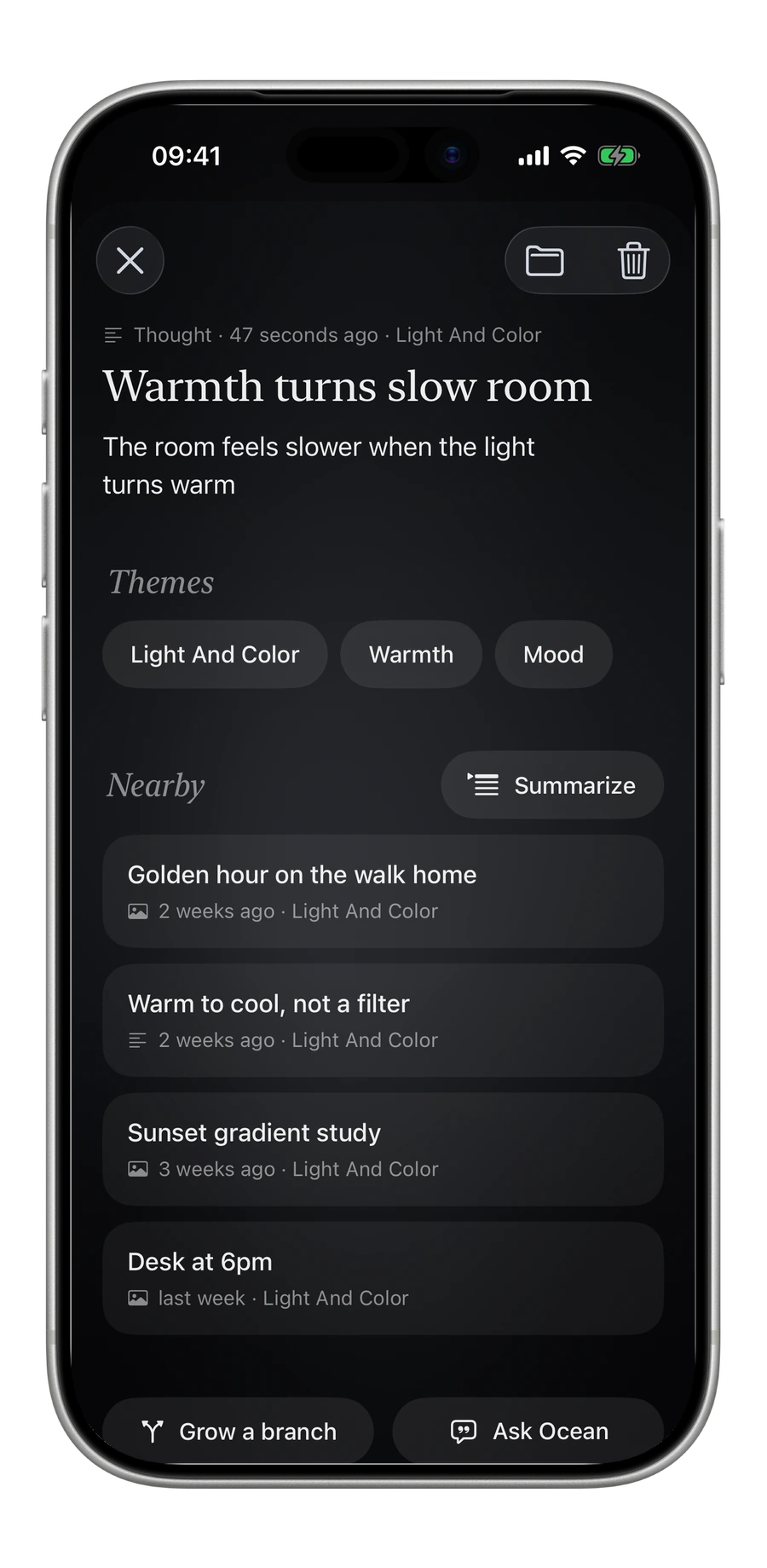
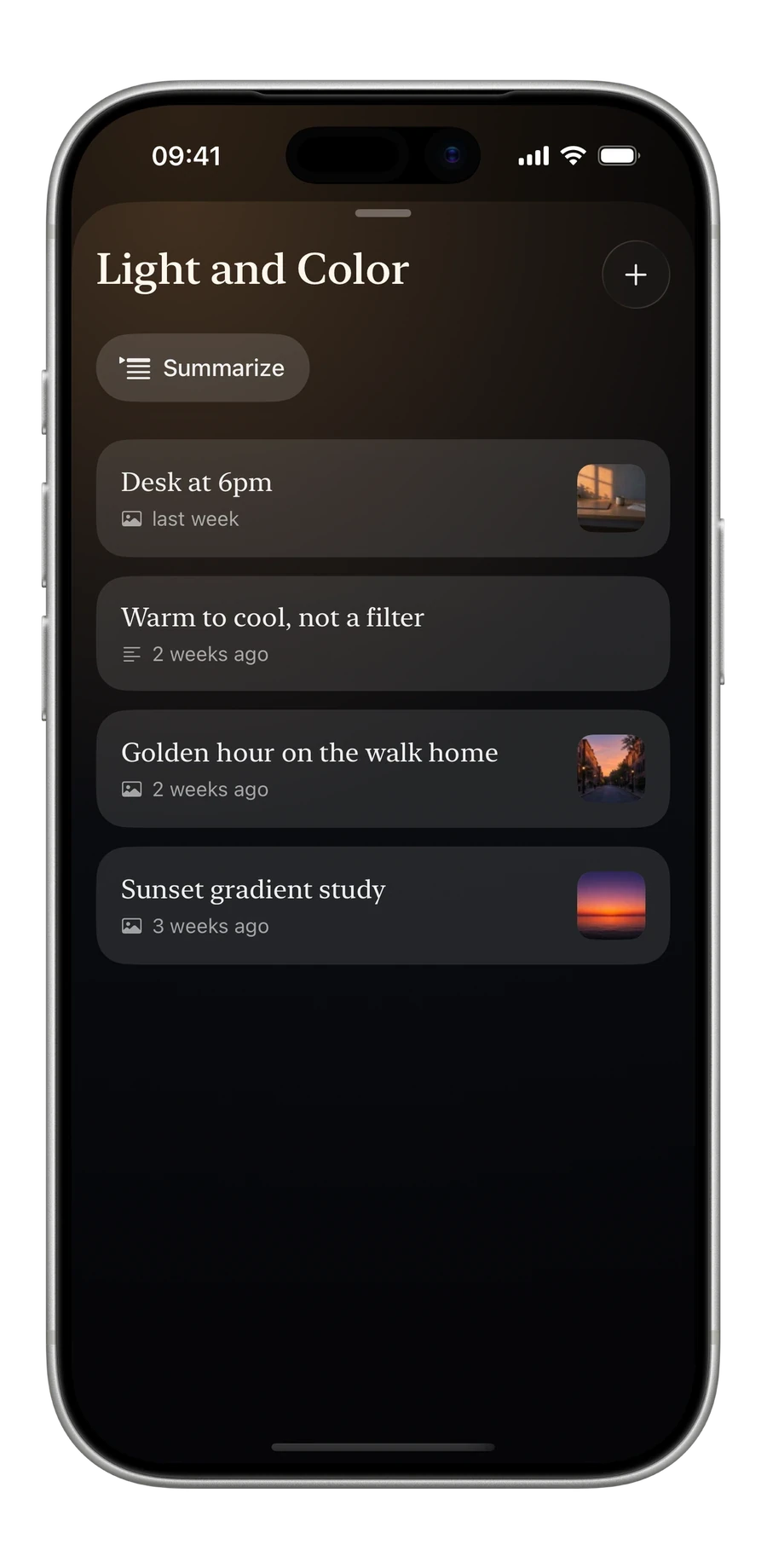
Related thoughts gather on their own. Nothing is filed.
Tide
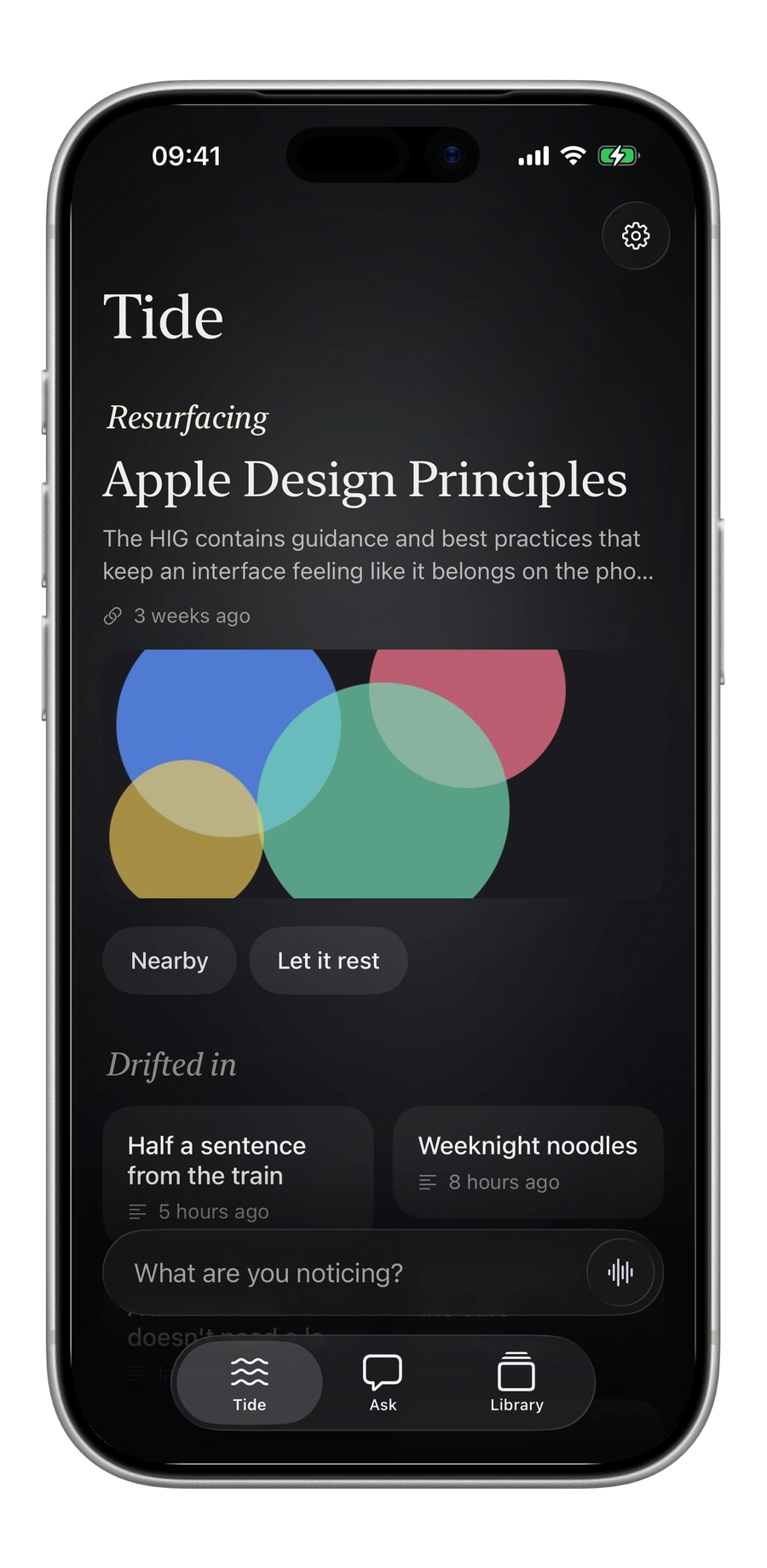
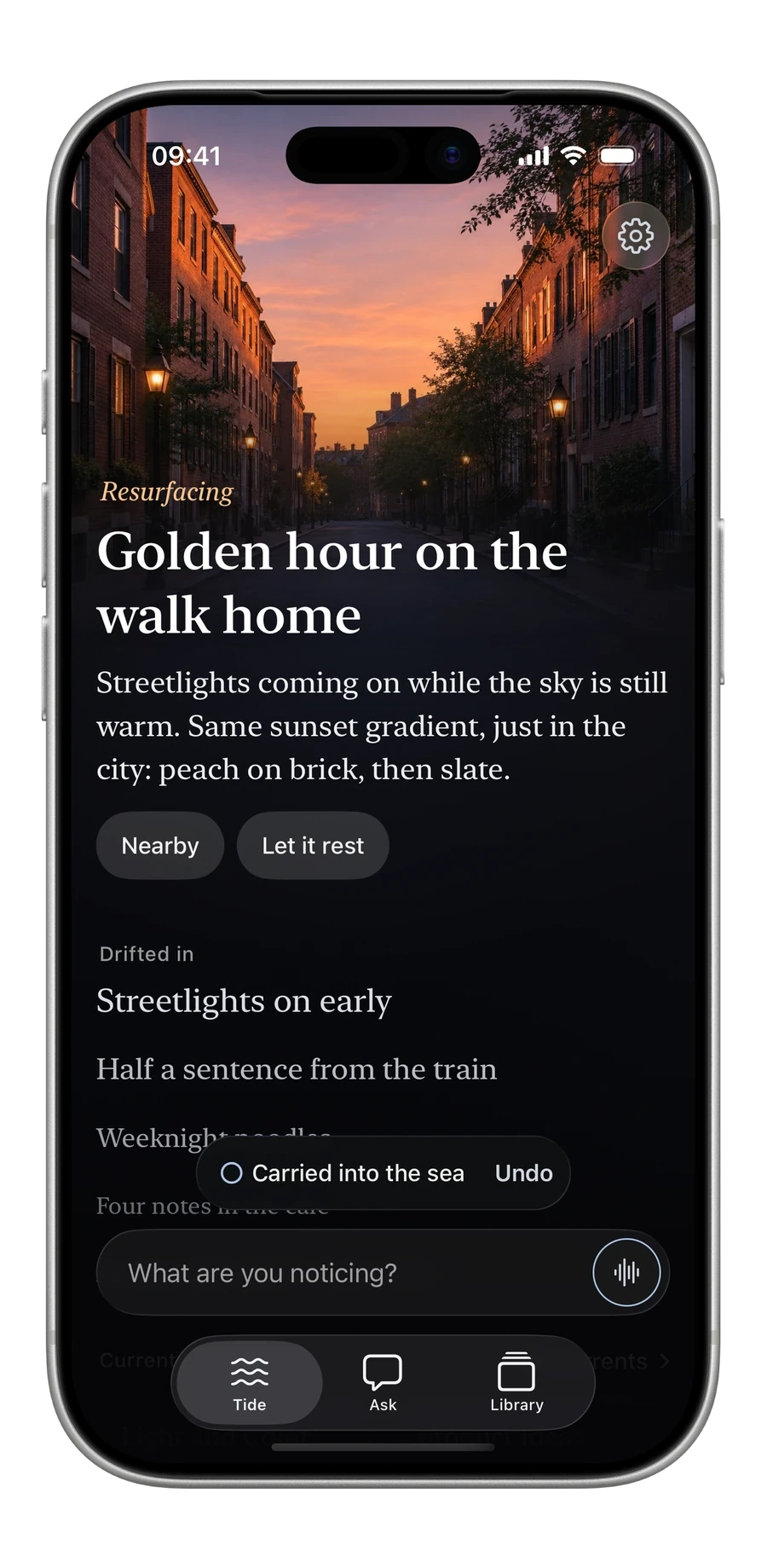
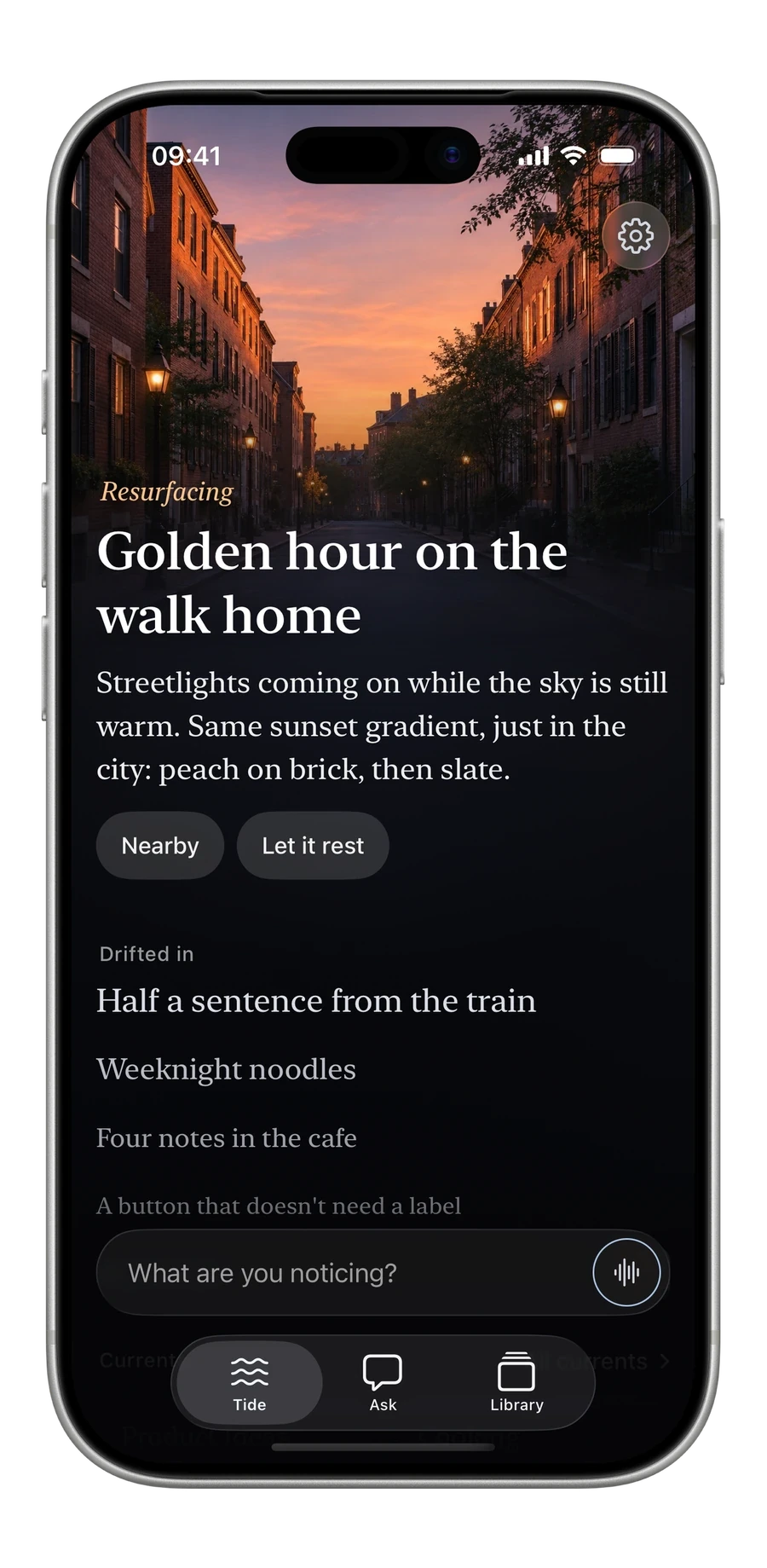
“The tide brings them back.”
The surface of the Ocean, read in a glance.
Resurfacing
“Let it rest”
One forgotten thought rises per day. Rest it, and the next does.
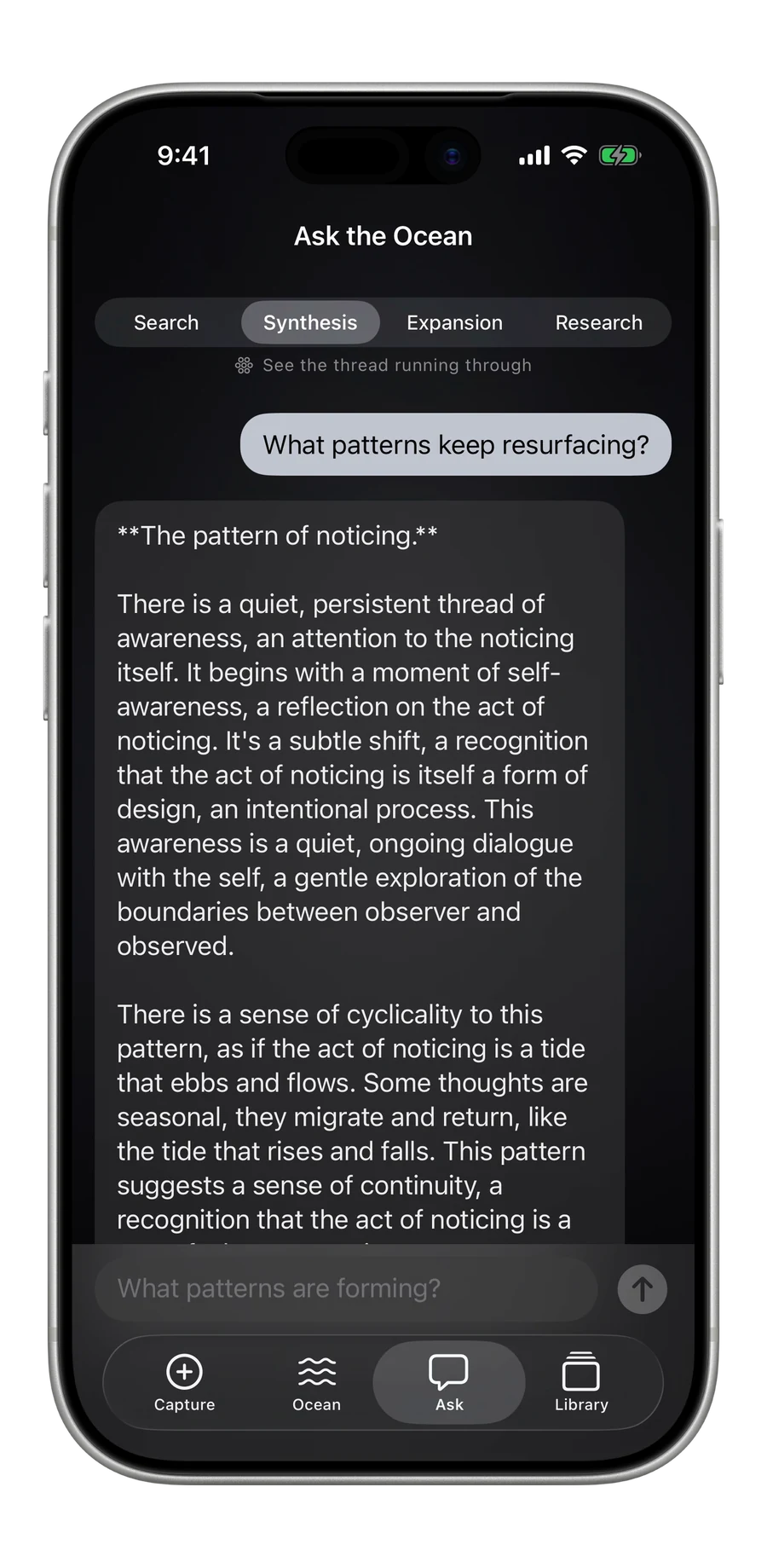
Ask the Ocean
“Nothing in your Ocean matches this yet”
A question answered only from your own thoughts.
Version 1
Twenty-three days to the App Store, then five releases in two weeks
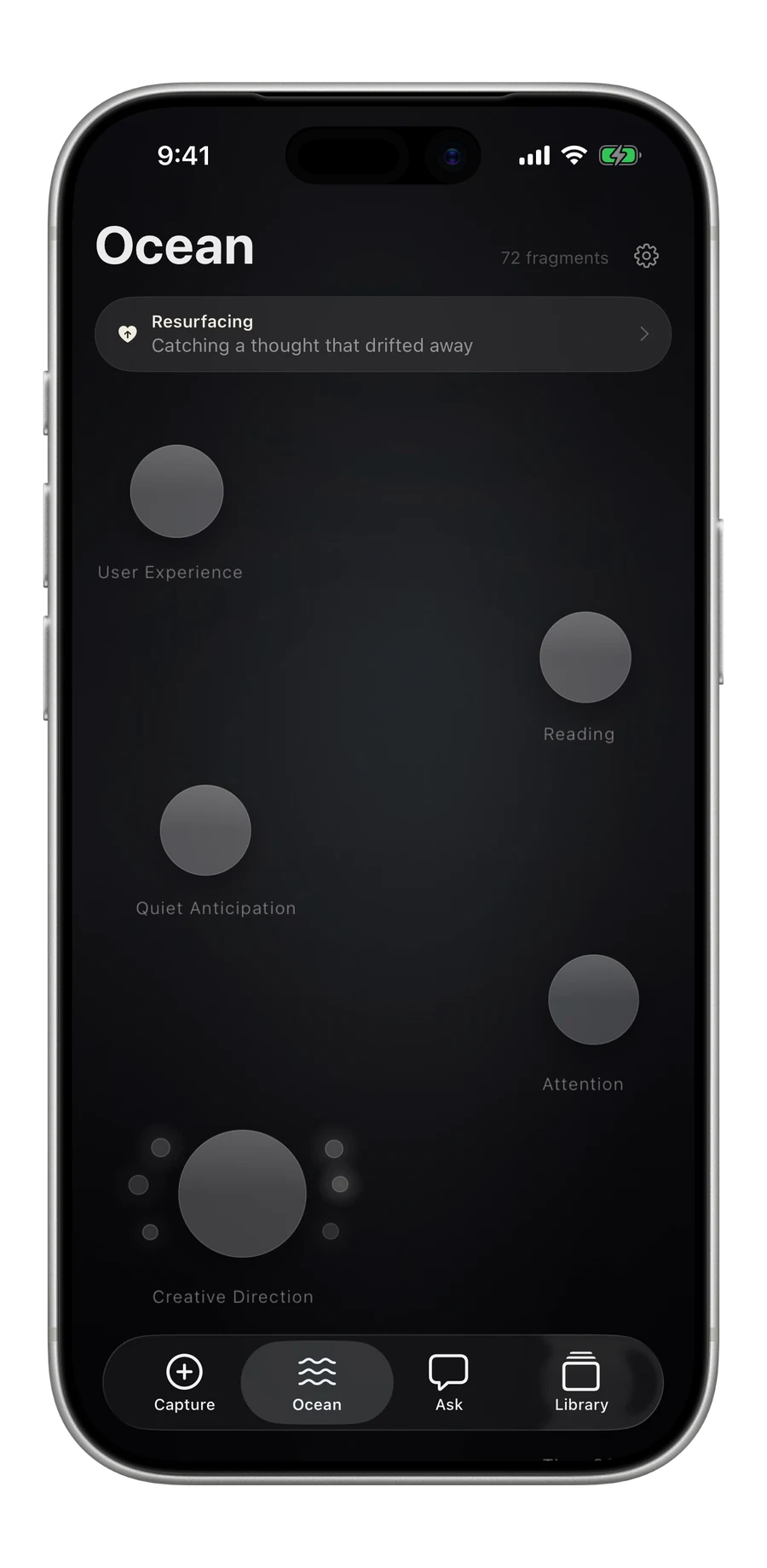
I had never written production Swift. The agent wrote the code and I designed the review: an auditor reading cold from a separate context, and a gate that lets nothing irreversible happen at machine speed. The first build had four tabs, Capture, Ocean, Ask, and Library, and the Ocean was a map of glass orbs that drifted in currents and lit up their relatives on a long press.
Launch film: 80 seconds of version 1, with sound
The 1.0 Listing, One Frame per Tab
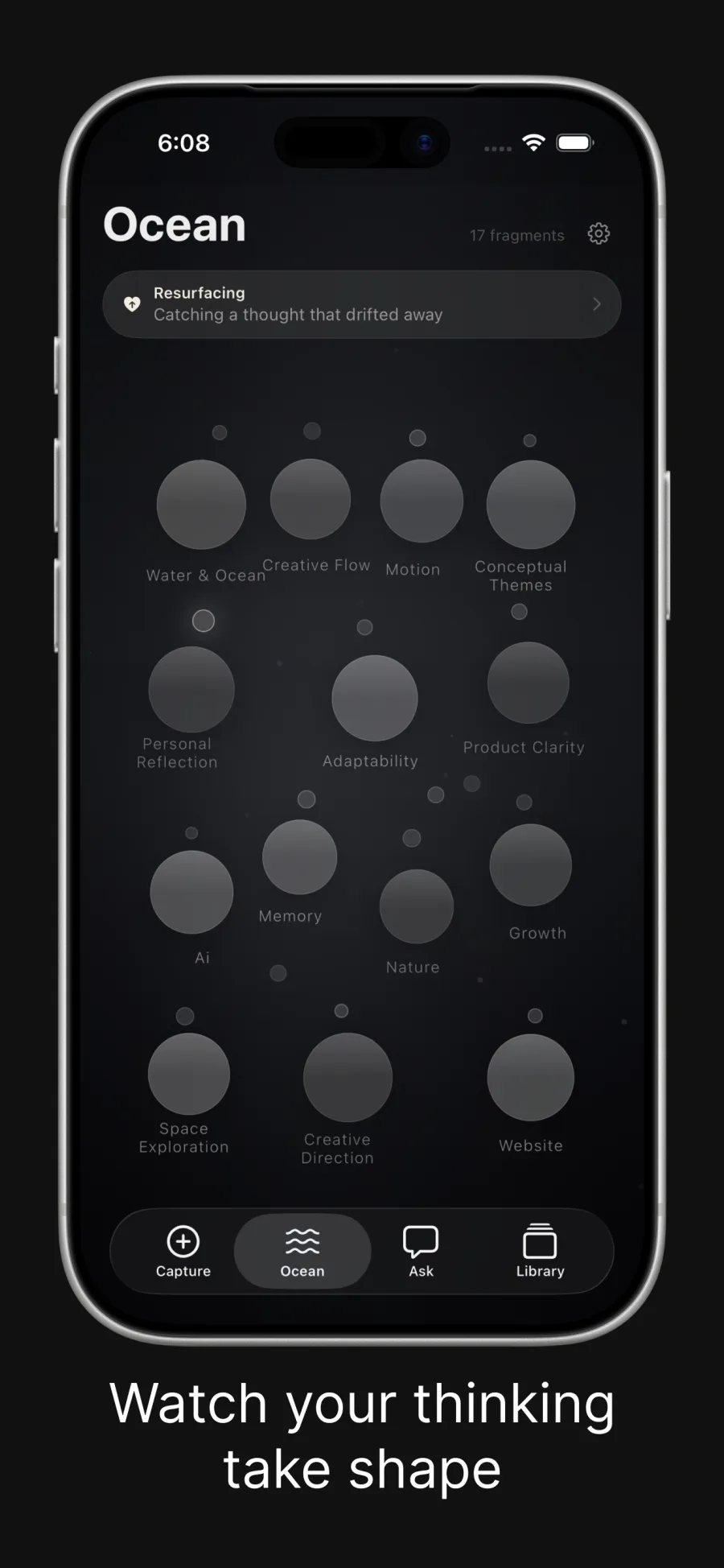
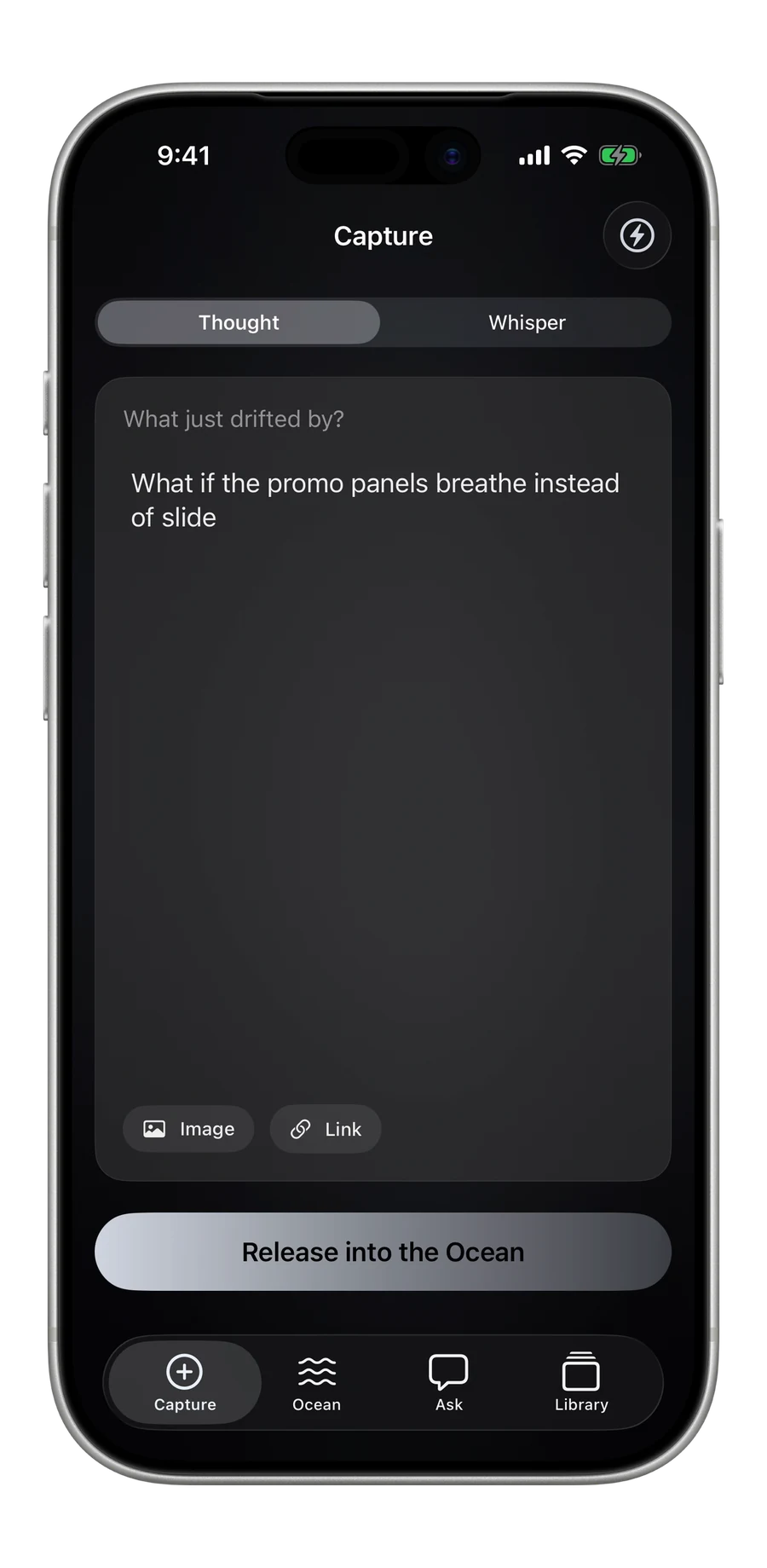
Capture
Ocean
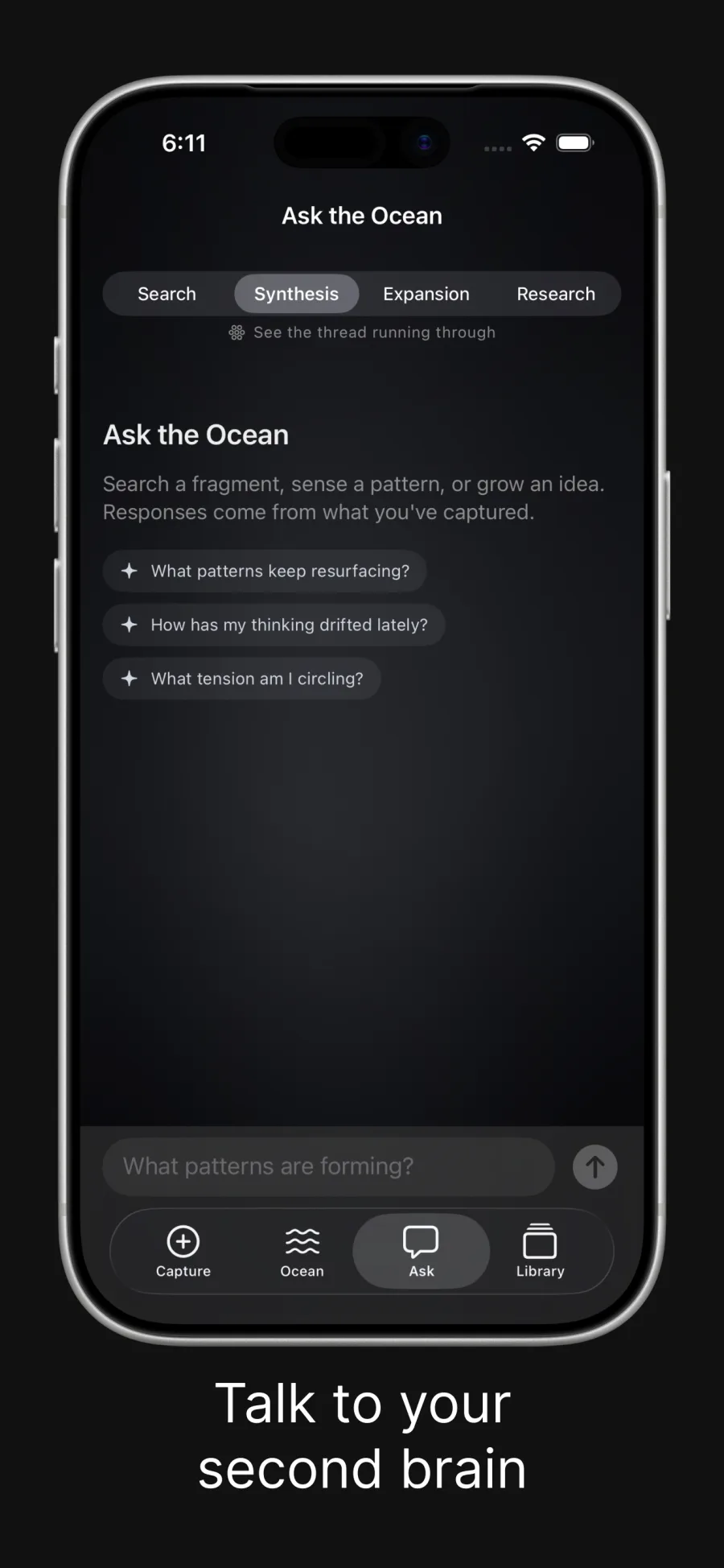
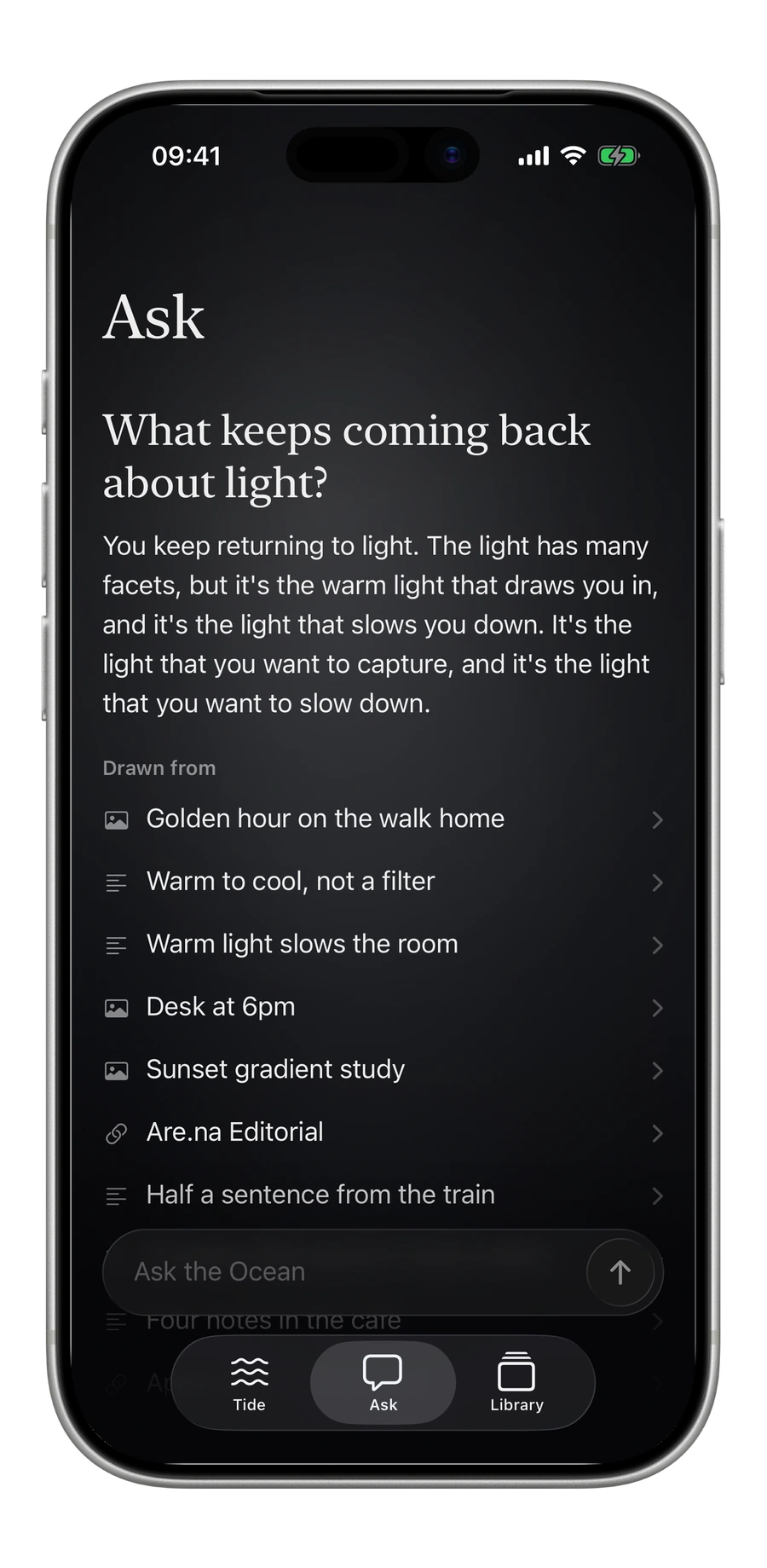
Ask
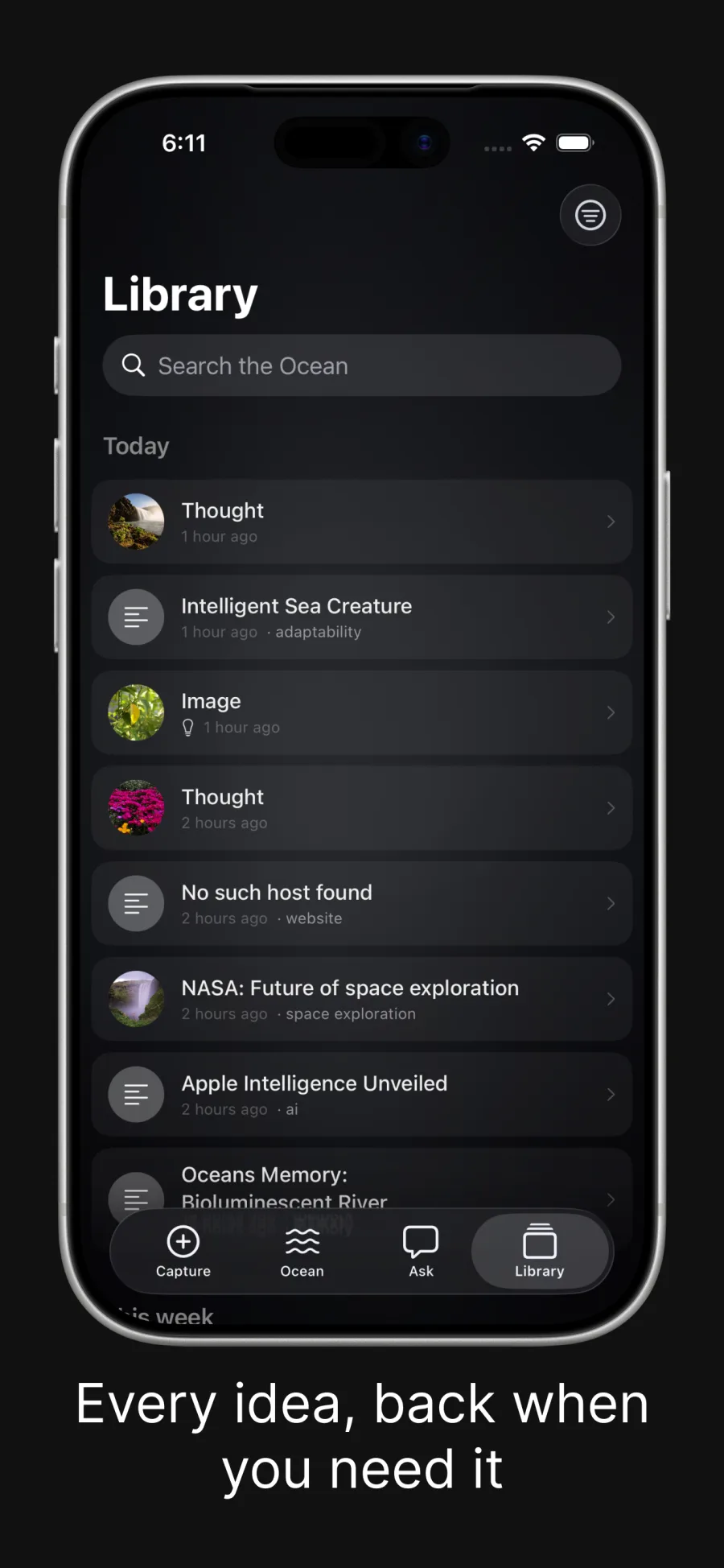
Library
Date
Release
What changed
Jun 9
First commit
Four tabs by the end of day one: Capture, Ocean, Ask, and Library.
Jul 2
1.0
On the App Store, 23 days in.
Jul 4–17
1.1 to 1.5
Five releases in two weeks: currents that breathe, export, a waterfall Library, Chinese and English transcribed on the device.
Oct 19
2.0
Three tabs, one gesture, Ask as one answer. Built over a weekend.
Oct 20
2.0 (2)
Oryne on Apple Watch: a whisper from the wrist reaches the phone on its own.
Oct 22–Nov 2
2.1
Pictures and links in the bar, a redesigned Library and watch, sharing a thought, and a new identity.
2.0 live on the App Store since October 21. 2.1 built, not yet released.
The map was the feature I was proudest of. Three months of carrying it taught me it answered no question a phone gets asked.
The Refocus
Three months in, the map left the phone
By October the honest reading was that the phone was never where ideas got explored. A phone is glanced at. What it is for is intake and the quick return: catch a thought in one gesture, and see what came back today. So one test was added to the principles before any code, and the map, the Capture tab, the four-mode Ask, and the review beat after a whisper all failed it.
Does this need more than a glance or one gesture on a phone? Then it belongs on the desk, and the phone's job is to get the thought there.
1.5 Against 2.0
Home
1.5: the Ocean, a map of orbs to pan and long press
2.0: Tide, a page read in three seconds: what came back, what drifted in
Capture
1.5: a tab, a Thought or Whisper picker, and a Release button
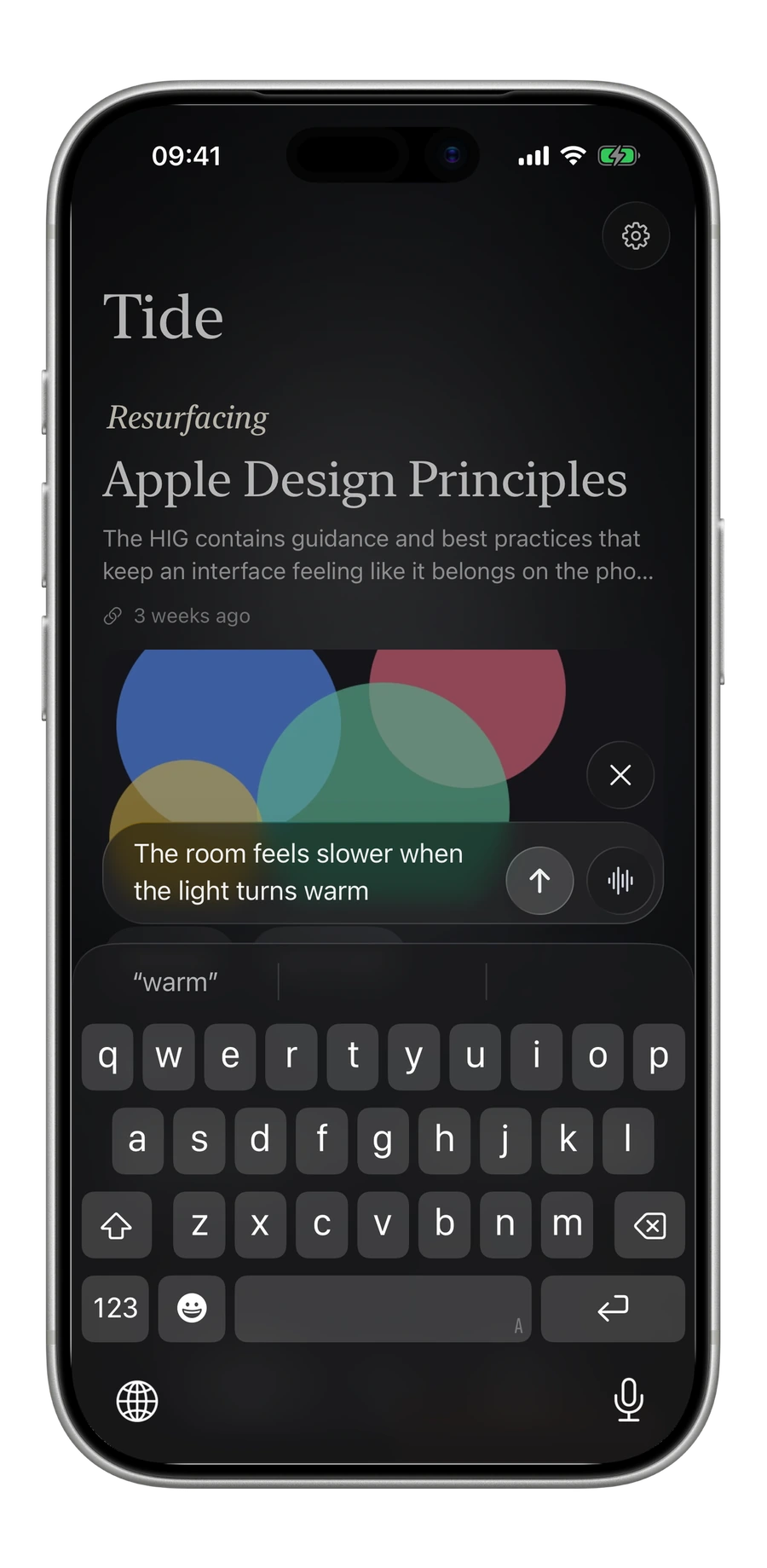
2.0: the bar: tap to type, hold the disc to whisper, one arrow to release
Ask
1.5: four lenses, Search, Synthesis, Expansion, Research, over a chat
2.0: one question, one answer, and every thought it was drawn from
Written Down Before the Code
01
The Ocean Is a Surface, Not a Map
Tide: today's thought, what drifted in, your currents. No pan, no zoom.
02
Capture Is a Bar, Not a Tab
A field and a disc above the tab bar, like a message composer.
03
Voice Is a Gesture, Not a Mode
Hold to whisper, lift to catch, slide up to lock. No picker.
04
The Review Beat Goes Away
Caught the moment the finger lifts. What remains is Undo.
05
Ask Stays, as One Mode
Four lenses become one question and one grounded answer.
06
2,179 Lines Fewer
The map, the Capture tab, the Ask modes, and the review beat left. The Swift came out smaller than it went in.
Over the weekend of October 17 to 19 the map left and Tide took its place: a page you can read in three seconds. The Capture tab became a bar, voice became a gesture, and Ask became one question with one grounded answer. The next day a watch app joined it, because the wrist is where a thought is cheapest to catch.
A quieter material
The second version also stopped rendering glass on everything. 2.0 is flat fills, with Liquid Glass only on the layer that floats over content, one lamp in the water behind the resurfacing thought, and New York, Apple's serif, in the three moments that name what a page is about.
A thought
1.5: glass panels, capsule tags, and a halo of light
2.0: text on the water, one order for every kind, type doing the grouping
Tested before a person saw it
On October 18 three AI testers ran the build on simulators: a first-time English user, a returning bilingual user, and a heuristic reviewer with Nielsen's list and the HIG. Their verdict was blunt: the set of functions is close to enough, and the reliability is not. Fifteen findings were fixed in the pass that followed. The two they called blockers lead the list for 2.1, and no person has tested 2.0 yet.
Fixed in the pass that followed
Undo lost the tap to the tab bar: now one centered toast for the whole undo window.
The save phrase rotated among four lines: now one, Carried into the sea.
Destructive confirms anchored to the wrong control with no Cancel: every one is the centered system alert.
Still open, the two blockers first
A deleted thought is gone for good: no undo, no recently deleted.
Ask cannot reliably re-find the user's own idea.
Hold-to-whisper cannot be discovered from the screen.
Final Design
One thought, from caught to returned
Eight screens of the 2.1 build, the release after 2.0, in the order a thought meets them.
01
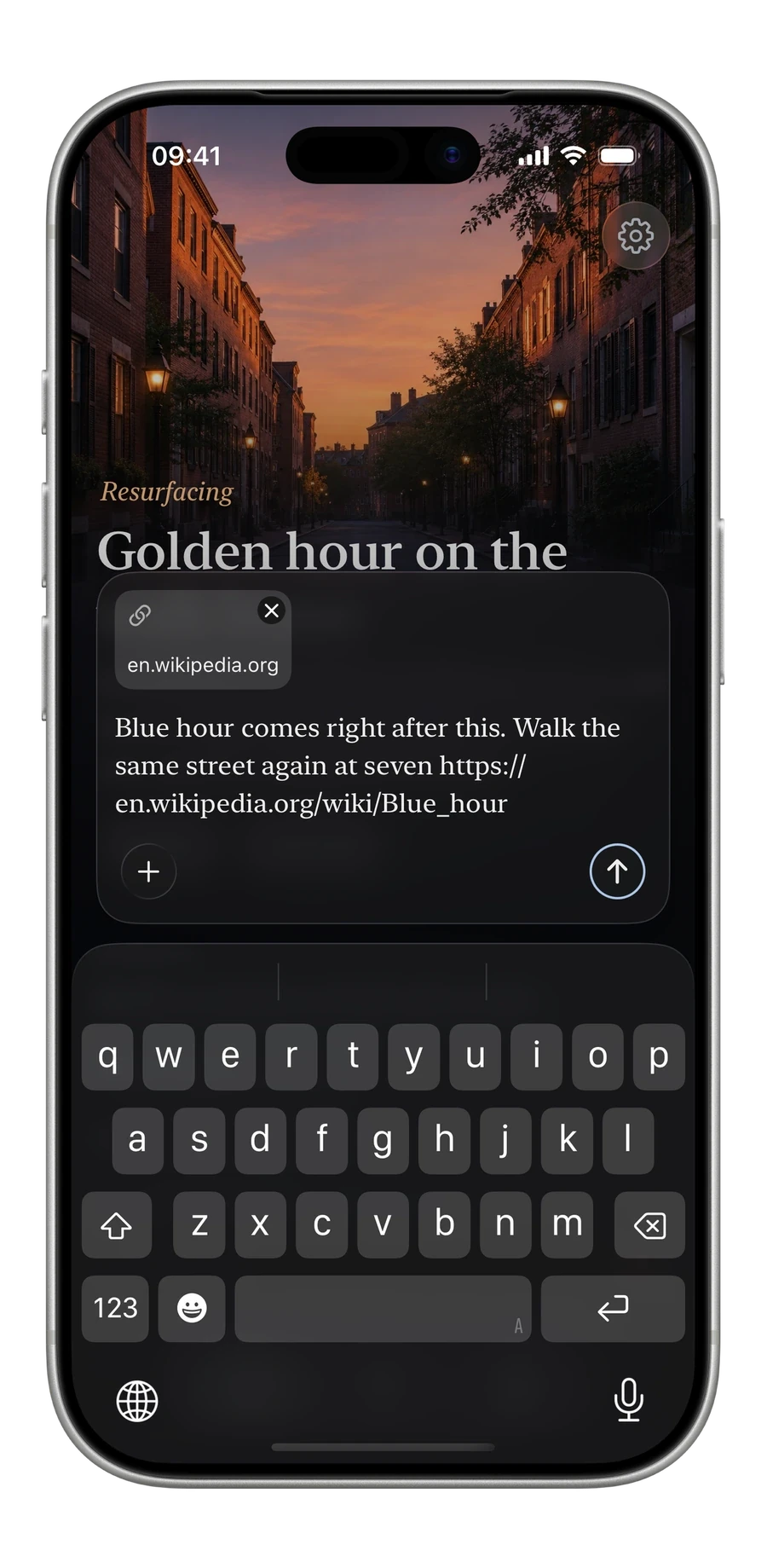
Catch
The bar: a link in the words becomes a card before release
02
Let go
Carried into the sea: saved before anything says so, and named on the phone
03
Drift
A current: related thoughts gather on their own
04
Return
Tide: today's thought stands on its own photograph
05
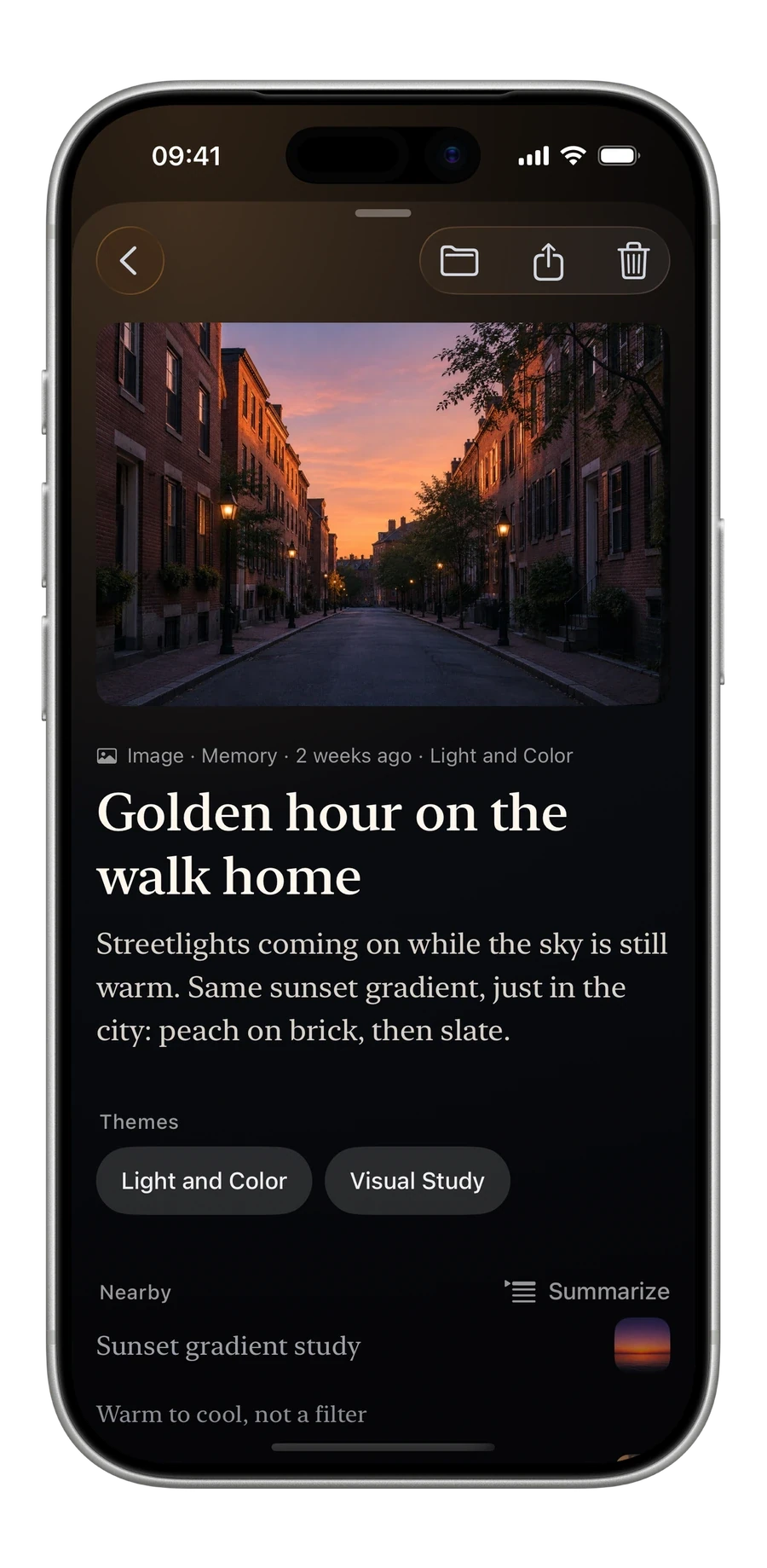
Open
A thought: the picture, then your words in serif
06
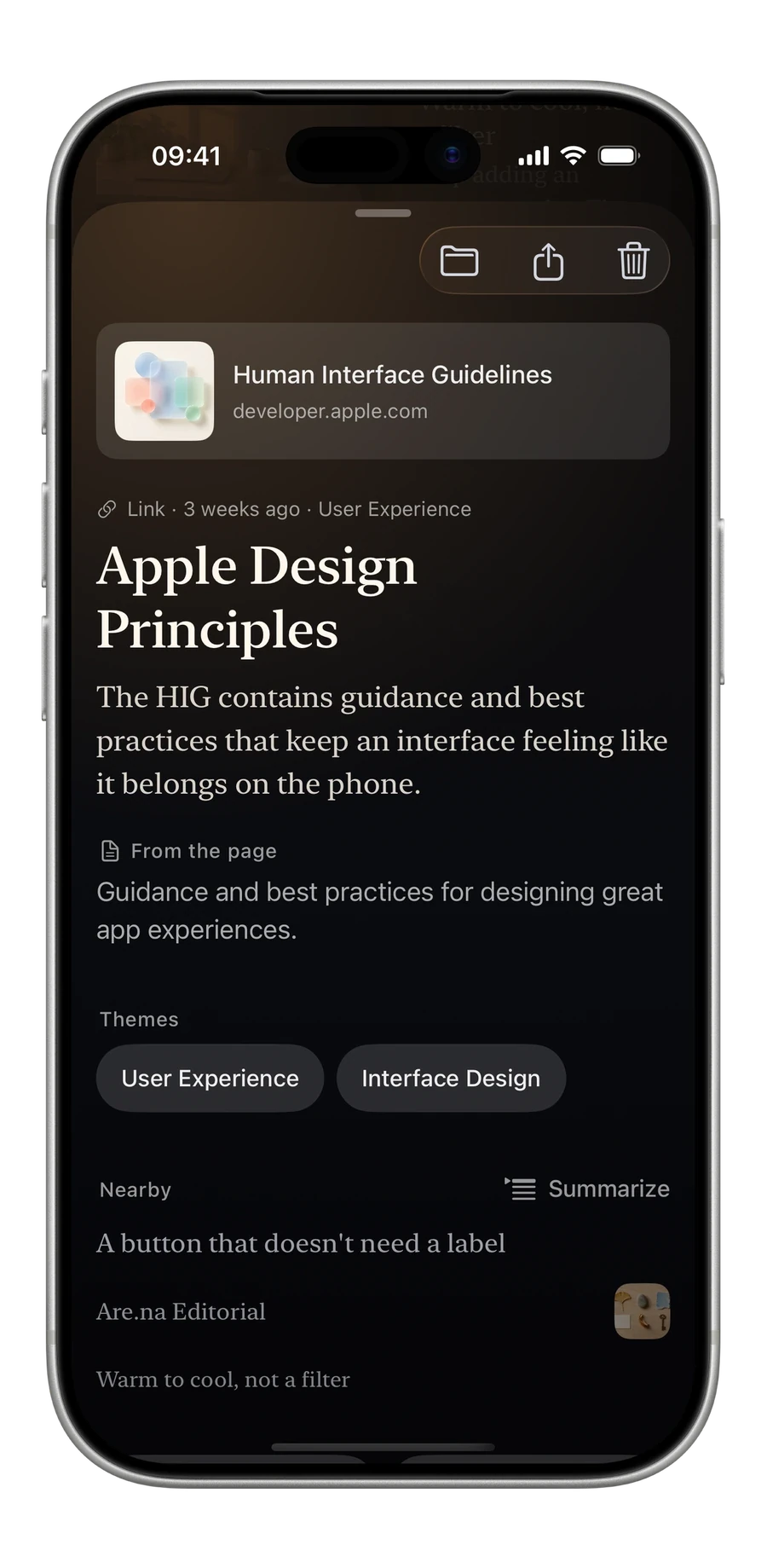
Keep a link
Link card: the card carries the link, the words stay yours
07
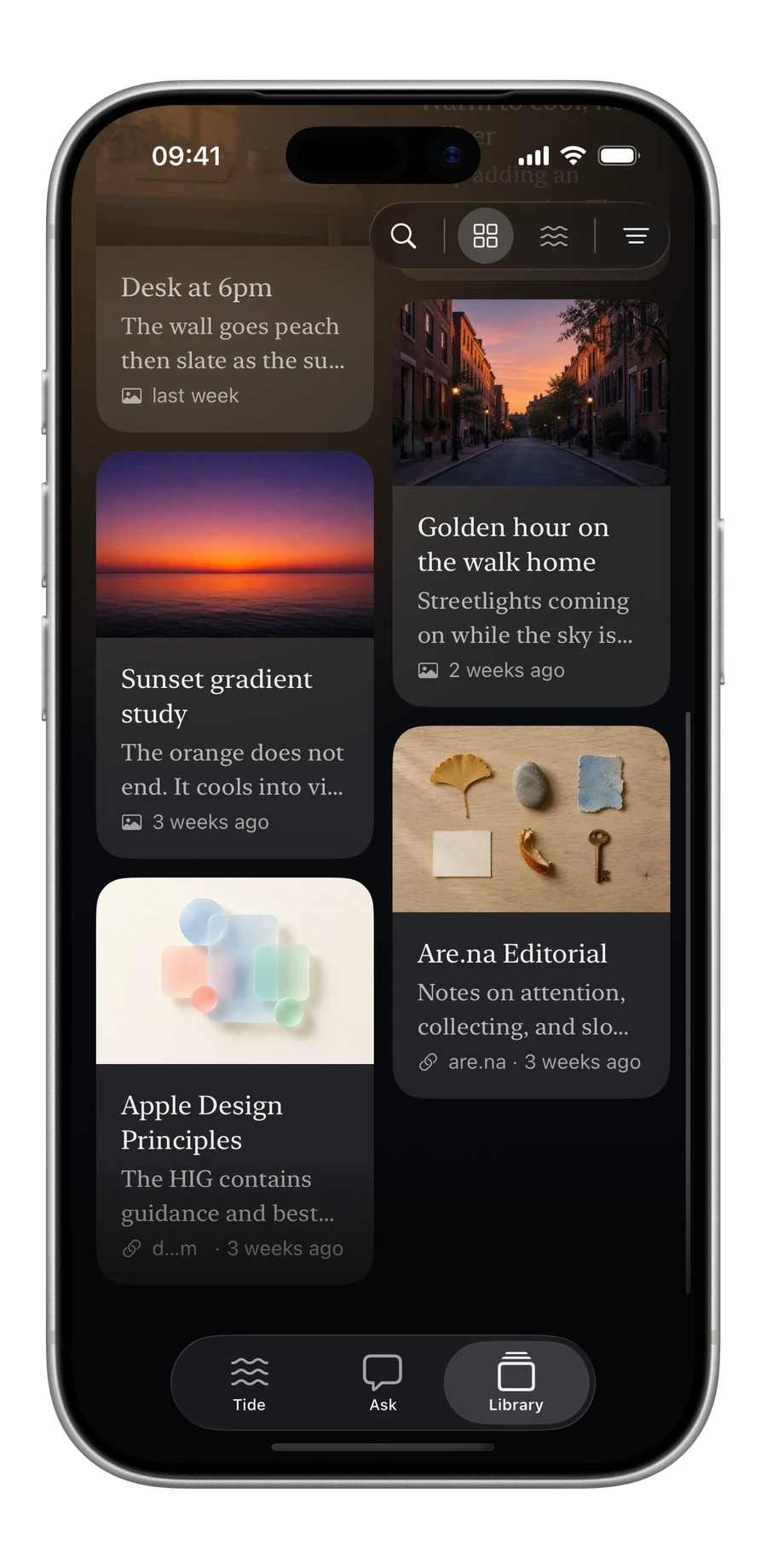
Find
Library: photographs, link covers, and words in one waterfall
08
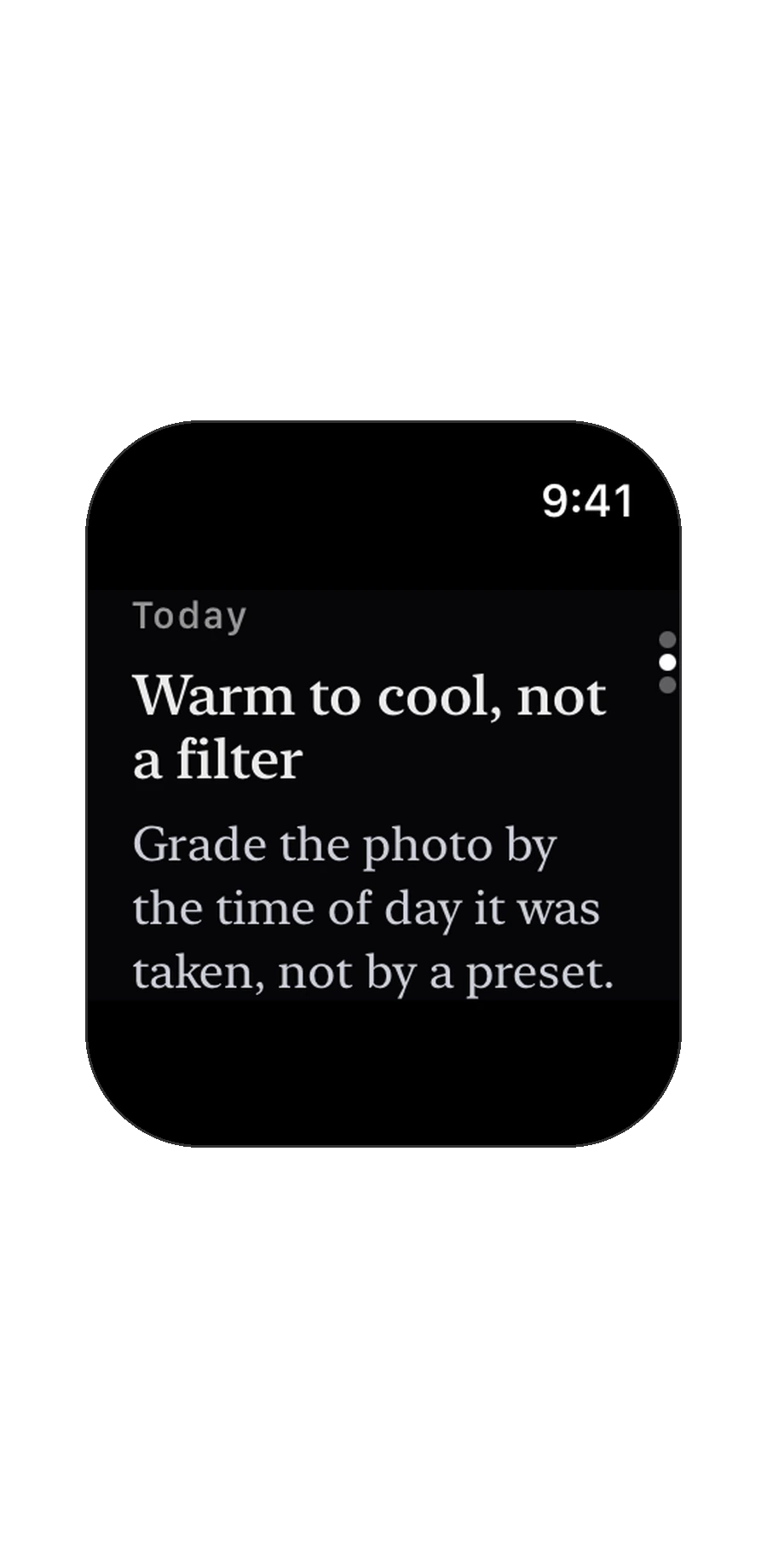
The Wrist
Apple Watch: today's thought, read at a glance
Capture in one gesture from anywhere. If a change would make someone hesitate before capturing, the answer is no. And what you are willing to capture depends entirely on where you believe it goes.
Nothing you capture leaves the phone
An inspiration tool only works if you will feed it your half-formed, 2 a.m. thoughts, so nothing you capture transits a server I can read. Naming, kinship, resurfacing, summaries, and transcription were all designed around what on-device intelligence can actually do rather than what a server could have done. I would make the same trade again.
01
On-Device Intelligence
Apple’s Foundation Models name, theme, relate, summarize, and answer.
02
Local Speech
Transcription on the phone, in both languages. A bilingual take runs both ways and the better one wins.
03
Your Own iCloud
Private CloudKit sync, phone to watch to phone. No server I can read.
What the Ocean Taught Me
Nearly every choice trades control for encounter
Nearly every choice trades control for encounter: browsing over managing, drift over sorting, restraint over reach. That is the trade I keep wanting to make, and the hardest version of it was taking my own favourite feature off the phone.
01
A Metaphor Is a Decision Machine
It answered questions about gestures, copy, and motion. Or it is decoration.
02
A Phone Is a Glance
Anything that needed more than one gesture belonged on the desk. Including the map.
03
The Best Features Are Refusals
Restraint does not demo well. It ships well. 2.0 shipped by taking out 2,000 lines.